Falling Confidence, Rising Anxiety
Confidence in U.S. elections rebounded after the 2024 presidential contest. However, new survey research from the Yankelovich Center for Social Science Research at the University of California San Diego finds that trust in the accuracy and fairness of U.S. elections is declining again across the electorate. Given that trust is a leading indicator of democratic participation and institutional legitimacy, this decline poses risk not only for outcome disputes after Election Day, but also for changes in who turns out to vote, especially among groups that feel targeted or unsafe.
Confidence is declining across parties
According to the Yankelovich Center report, only 60% of Americans say they are confident votes will be counted accurately nationwide in 2026, down from 77% immediately after the 2024 election. The shift is particularly notable because it is not confined to one party. Confidence fell among Democrats (13 points), Republicans (17 points), and independents (16 points) alike.
This pattern aligns with Pew Research Center work showing that confidence in vote counting is often higher locally than nationally, and it can shift meaningfully between cycles depending on the political environment and perceptions of election administration.
Findings from the Yankelovich study show that sources of concern vary by partisan identity: Republicans are more likely to express concerns “that ballots cast by mail are counted accurately” and more likely to “distrust in non-citizens being prevented from casting their ballots.” Meanwhile Democrats and Independents are more likely to express concern that “Congressional district lines are drawn to fairly reflect what voters want.” These findings also mirror those by Pew that partisan confidence tends to track which party perceives itself as disadvantaged by election rules or administration.
Confidence in elections matter because they can shape decisions to turnout to vote and acceptance of election results, which are critical for democratic participation and institutional legitimacy.
ICE and Intimidation at the Polls
The Yankelovich Center report also surfaces new concerns about the presence of Immigration and Customs Enforcement at the polls this year. 37% of respondents think it is likely that federal immigration officers (such as ICE) will be present at voting locations in their area and expectations are higher among Hispanic (45%), Black (44%), and Asian American (41%) respondents than among white (33%) respondents.
When asked whether ICE presence would change confidence that votes will be counted as intended, more respondents in every racial and ethnic group said it would make them less confident rather than more confident. 46% of Hispanic and Black respondents worry about facing intimidation at polling places, compared with just 10% of white respondents.
This matters because election research shows that even perceived barriers and intimidation can depress turnout even when actual access remains unchanged.
What to Do
Civic organizations should treat “confidence and intimidation perceptions” as a turnout risk that can be mitigated by providing accurate information through trusted messengers in their communities (e.g. local election officials, veterans, faith based leaders) and visible support at/around voting sites. They can also provide rapid-response information and legal protection. Finally, community-based education and events that encourage and celebrate voting will motivate and help ensure that people do not feel alone.
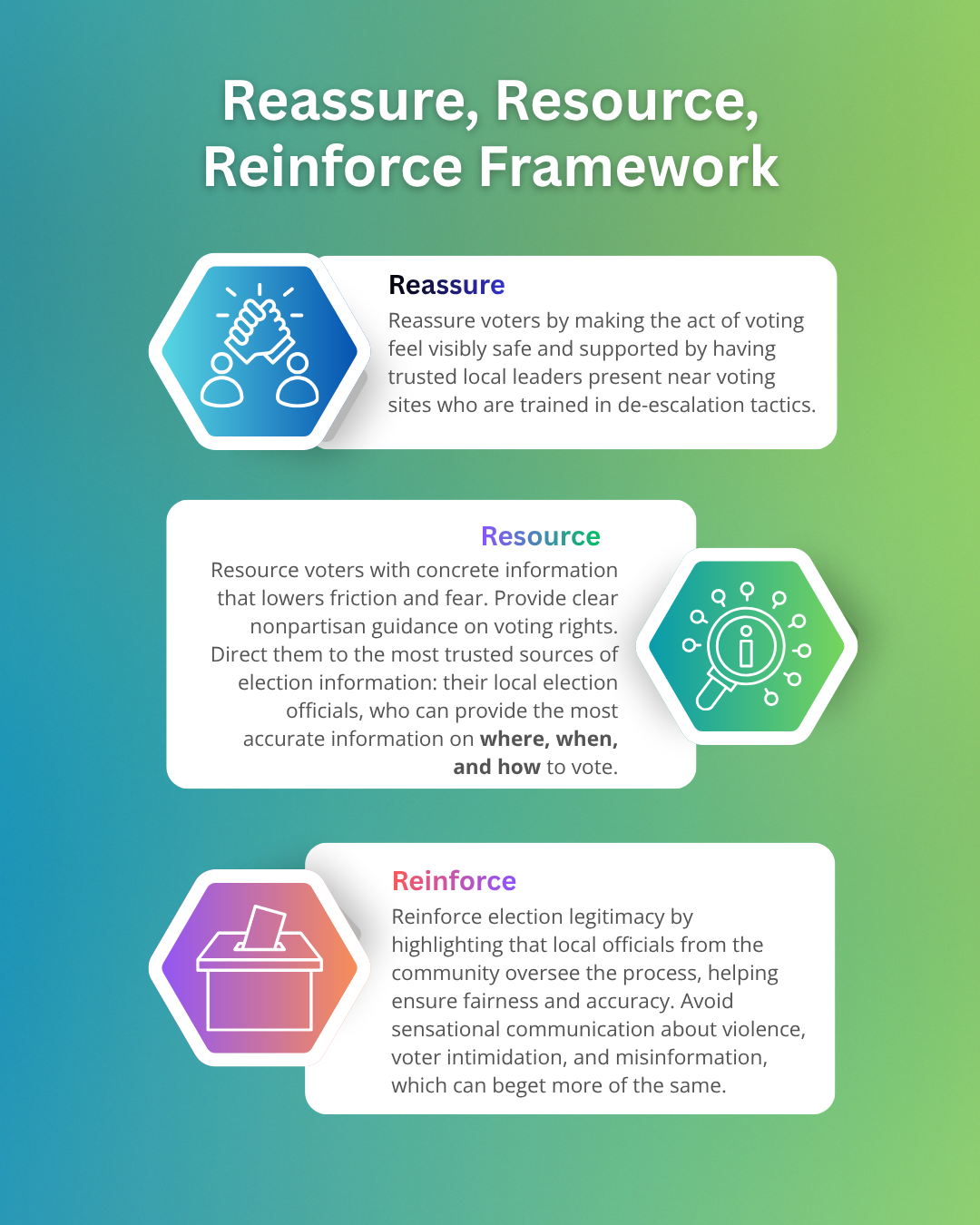
Civic organizations can respond with a simple “reassure, resource, reinforce” framework.
Reassure voters by making the act of voting feel visibly safe and supported by having trusted local leaders present near voting sites, who are trained in de-escalation tactics.
Resource voters with concrete information that lowers friction and fear. Provide clear nonpartisan guidance on voting rights. Direct them to the most trusted sources of election information: their local election officials, who can provide the most accurate information on where, when, and how to vote.
Reinforce election legitimacy by highlighting that local officials from the community oversee the process, helping ensure fairness and accuracy. Avoid sensational communication about violence, voter intimidation, and misinformation can beget more of the same.